Thursday, May 22, 2014

Emily Davison and The Kings Horse


Emily Wilding Davison

(11th October 1872 - 8th June 1913)

Emily Davison was a suffragette, an 'intelligent woman who had funded herself through first class honours degrees at Oxford and London' universities.
(Ellis, C. 2013, P.90).

Emily Davison joined WSPU in 1906 and participated in their tactics to disrupt the government. Emily Davison was arrested nine times and force fed a total of 49 times. (Brown, 2013, p.107).

On the night of 1911 Census she hid in a cupboard in the House of Commons forcing this to be registered as her home address. She is listed twice on the 1911 Census - once at home and once with her address as “Found Hiding in Crypt of Westminster Hall Westminster”(Ancestry.com, 2011).

 A  plaque was later set in place in Westminster in 1999 to commemorate the event.     
(Ancestry.com, 2011)
1911 Census


The Epsom Derby.

On the 4th June 1913 at the Epsom Derby Emily Davison stepped in front of Amner the horse of King George V (Brown, 2013, p.110). Instantly knocked down 'she died from her injury's four days later' (Smith, 2005, p.42) on the 8th June 1913.


http://www.bbc.co.uk/history/0/22596311

The intentions of Emily Davison on this fateful day will never be truly known. Some considered she intended to become a martyr to the suffragette cause by committing suicide. However, the majority of people believed this was a tragic accident, as her death was recorded as such with a verdict of misadventure. (Brown, 2013, p.111).

http://www.bbc.co.uk/news/uk-england-surrey-22703704

Emily Davison did not leave a suicide note to her mother Margaret and in her belongings there was a 'return rail ticket' (Ellis, C. 2013, p.90).This would lend itself to the idea that this was not suicide. This does not, however, prove whether this event was planned or an act of impulsion.


It is widely believed that she was trying to pin a suffragette flag to the king's horse so that once it crossed the finish line it would be photographed displaying the suffragettes colours (Brown, 2013).

Emily Davison's funeral procession lined the streets of London, was escorted by hundreds of grieving suffragettes 'this has become an iconic image of the early twentieth century' (Smith, 2005, p.42).

Like all the previous acts of the suffragettes the opinion surrounding Emily Davison's actions left people divided. Her death shocked many, but she was also 'sent hate mail as she lay unconscious in hospital' (Ellis, C. 2013, p.90) Here is video footage from that fateful day, what is your opinion?. 

                 
                                          https://www.youtube.com/watch?v=TH_r6-JpO9Q

Given the evidence that Emily Davison had not shared her plan with any of her fellow suffragettes I believe it was possibly a spur of the moment act. The evidence that called for her inquest to record a verdict of misadventure appears to rule out suicide. I cannot think that somebody like Emily Davison who had played such an important part in the campaign would wish to leave it so dramatically, especially without leaving a note to this effect. I can only imagine the frustration of these suffragettes, always looking for the next available opportunity to raise awareness, maybe Emily Davison thought this was her opportunity.  


Wednesday, May 21, 2014

World War One and the Changing Attitude to Women


Women's reaction to the war.


During World War One ‘more than a million women took the chance to join the workforce’ (BBC, 2014) to fill the gap left by men who went to war. Many people had spent years arguing that women were the weaker sex and this was why they did not have the equality they craved. The onset of war gave a stage for women to dispute this idea as they were 'able to prove their worth both in war and in diplomatic services' (Sarmah, 1997, p.120).
Women working in Woolwich Arsenal during the First World War
http://www.bbc.co.uk/guides/z9bf9j6

Two days after England declared war on Germany the national union of women's suffrage societies (NUWSS) 'announced it was suspending all political activity until after the war was over' (Cawood, 2013, p.77). On August 7th 1914 the Home Secretary released all suffragettes from prison. The women's social and political union (WSPU) then announced they would be suspending all militant action and also joined the war effort
(Cawood, 2013, p.77).


Women's opportunities in the war.


http://www.bbc.co.uk/guides/z9bf9j6#zpmjpv4
During the war women proved they were strong and able to withstand the conditions left by the absent men. As well as the men’s work they had taken on, the women still had their own work to do ’12 hour shifts were common – and some women worked 13 days without a break’ (BBC, 2014) there was no work life balance available.


http://www.bbc.co.uk/guides/z9bf9j6#zpmjpv4
When the troops returned The 1919 Restoration of Pre-War Practices Act was introduced this ‘forced most women to leave their wartime roles as men came home and factories switched to peacetime production’ (BBC, 2014). In 1918, those women who managed to stay in their jobs were still being paid less for doing the same as men (BBC, 2014).

Many women were forced back into their domestic home life, some with the addition of injured male relatives to care for. When considering this I can only imagine the frustration these women must have felt. They had campaigned for so long arguing their worthiness for equality, they then prove this and still it seemingly counted for nothing as they were expected to resume their pre-war positions and ‘found themselves thrown out of work and back into the kitchen almost overnight’ (BBC, 2014).


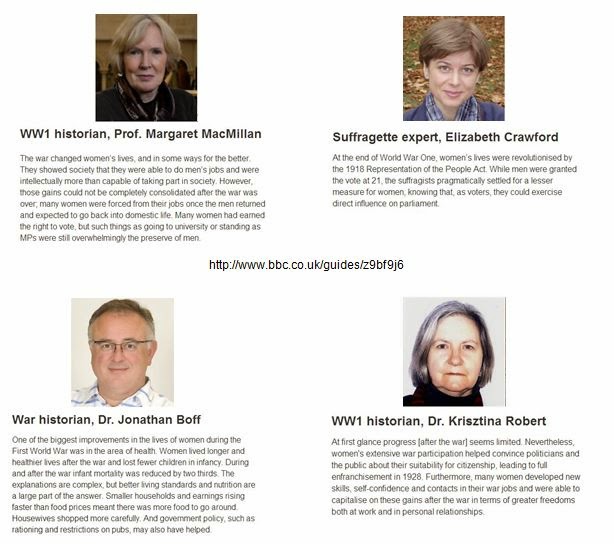
Expert Opinions.

Here are some expert opinions on the attitude towards women after world war one. These four experts were interviewed as part of the BBC Radio 4's Womens Hour, this particular episode World War One: Changing Women's Lives was aired on Wednesday 5th February 2014. If you would like to watch this episode then you can access it via the QR code or the link below.


The QR code opposite can be scanned with any device that has a QR reader. This will start the BBC programme:

World War One: Changing Women's Lives


       http://www.bbc.co.uk/programmes/b03thdbh/qrcode


Tuesday, May 20, 2014

Why were Women Granted the Vote?

Women after the War 

In the decade that followed the end of World War One the position of women in society changed dramatically in Britain. In the same year that the war ended property owning women over the age of thirty were granted the vote under The Representation of People Act 1918 (Trueman, 2000). Although this was not the universal suffrage they had hoped for many women accepted this 'on the grounds that it was obvious that votes for all women could not be long delayed' (Kelly & Lacey, 2001,p.36). In reality it was a whole decade before all women were granted the vote in 1928.


Timeline of events regarding women after World War One


Why were women granted the vote?

Perhaps a simple and logical answer to this question would be that the vote was granted due to the contribution that women made during the war. This response would certainly have been welcomed by WSPU members, the orders given by Emmeline Pankhurst to suspend militant action and support the war effort were said to 'put moral pressure on the government to grant them the vote' (Kkorte & Schneider, 2002, p.167). The problem with this response, however, is that not all women reaped this reward. During the war 'women of all classes and backgrounds' (Frank, 2008, p.71) joined the war effort, yet under The Representation of People Act 1918 only property owning women over the age of thirty were given the vote (Trueman, 2000). This shows little evidence that 'suffrage was conceded as reward for womens contribution to the war effort' (Cawood, 2013, p.77).

Threat of the Suffragettes.

It is documented that, in comparison to Britain 'women in France did equally as important work in World War One but did not receive the right to vote after the war' (Trueman,2000). The main difference before the war was that there was 'no pre-war suffragist movement in France - and certainly not the militancy of the Suffragettes' (Trueman, 2000). The British nation was left exhausted by the war effort but women had a new sense of self worth, In 1918 trade union leader, Mary Macarthur shared her belief in profound change:
"Of all the changes wrought by the War, none has been greater than the status and position of women, and yet it is not so much that woman herself have changed as that mans conception of her has changed' (Thom, 2000, p.1)
The view that women were too weak to do mens work was no longer valid. If the expectations of these women were not met the suffragette campaign could be stronger than ever and 'there was nothing to stop them starting again once the war was over' (Chandler, 2001, p.26). If this is to be the believed reason for granting women the vote then maybe the militancy of the suffragette campaign did pay off after all.


The Suffragist Campaign.

The suffragists fought a long campaign gathering political support along the way. This support helped when 'the wartime government became a coalition of all the political parties' (Kelly & Lacey, 2001, p.35). This included the parties that supported the idea of womens' suffrage. Lloyd George was 'a prominent supporter of women's rights' 
(Kelly & Lacey, 2001, p.35) he became Prime Minister in December 1916, therefore, there is an argument that women would have gained the vote anyway.

Political Reasons.


During the war in 1917 'the government became aware of the need to call an election' (Bourke, 2011). This created a problem as the voting rules stipulated that only men 'who had been resident in the country for 12 months prior to the election were entitled to vote' (Bourke, 2011). This meant that all the troops serving overseas in the war were disenfranchised. The government were then forced to revise the voting rules. During this revision they could not ignore the war effort of women and the continued 'persuasive arguments of Millicent Fawcett and the NUWSS' (Bourke, 2011) the government could not 'gamble that these women would not join the Suffragettes thus strengthening their numbers and engage in violent activities '(Trueman, 2000). Liberal leader, Asquith, then granted a minority of women the vote under The Representation of People Act 1918. Although this was welcomed as a breakthrough in the issue of female suffrage it was 'a remarkably conservative measure to keep the suffragists happy but also delay more radical reform' (Trueman, 2000). Conservative MP’s and those in other parties that opposed the issue of female suffrage 'may well have seen the act as a success in that it could have gone a lot further' (Trueman, 2000). They did not consider a threat to the political order from 'the women that gained the vote in 1918 as they were more likely to be married, have children and no interest in a career' (Cawood, 2013, p.77) it was also assumed that 'they would follow the lead of their husbands and fathers' when voting (Nichols, 1983, p.42).


Women Voters going to the Polls
Kelly, N. & Lacey, G., 2001. Modern World History for OCR Specification 1937: Core. Portsmouth: Heinemann.